Can Power Survive on Force Alone?
Political power does not depend solely on the capacity to use force. A durable political order also requires people to regard a particular form of government as legitimate, reasonable, or necessary. Therefore, governments need not only military and economic resources but also intellectuals who produce knowledge, interpret events, and shape social meanings.
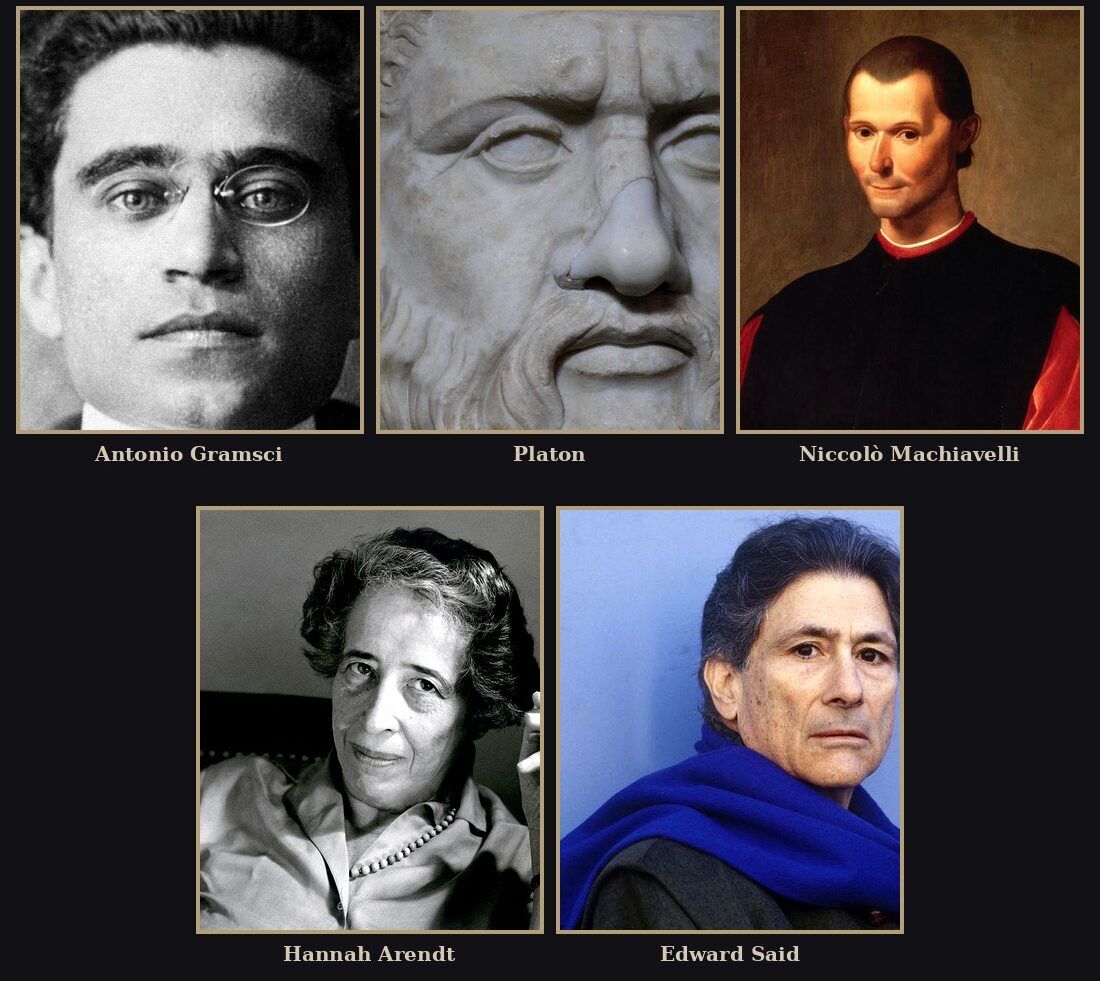
From Plato and Niccolò Machiavelli to Antonio Gramsci, Hannah Arendt, and Edward Said, many thinkers have examined the relationship between knowledge and political power. Plato associated the right to govern with knowledge and wisdom, while Gramsci placed intellectuals at the center of the formation of social consent. Machiavelli, meanwhile, regarded the ruler’s relationship with advisers as an important component of political judgment.
This leads to a fundamental question: Why does political power need the knowledge, prestige, and social influence of intellectuals?
The Basic Relationship Between Intellectuals and Power
An intellectual does not simply produce academic knowledge. In a broader sense, an intellectual interprets social events, develops concepts, questions established ideas, and contributes to the way society understands the world.
From this perspective, intellectuals matter to political power for three main reasons: legitimacy, knowledge, and social consent.
A government may possess economic resources and coercive institutions. However, if people regard that government as entirely illegitimate, the political cost of maintaining power increases. Intellectuals become important at precisely this point. They can place political decisions within historical, legal, moral, or economic frameworks.
Consequently, political actions do not necessarily appear merely as exercises of power. An intellectual explanation can present the same action as a “necessary reform,” “social order,” “national interest,” or “historical necessity.”
Gramsci: Social Consent as a Powerful Instrument of Rule
Antonio Gramsci provides one of the most important frameworks for understanding the relationship between intellectuals and political power.
Gramsci argues that ruling groups cannot maintain power through coercion alone. In modern societies, dominant groups also seek to secure social consent. Gramsci describes this process through the concept of hegemony. Hegemony involves not only political domination but also intellectual and moral leadership.
Intellectuals play a crucial role in this process. Gramsci does not restrict the concept of intellectual to professors, philosophers, or writers. Managers, technicians, bureaucrats, scientists, and other groups that connect knowledge with social organization can perform intellectual functions.
Gramsci also develops the concept of the “organic intellectual.” An organic intellectual articulates the worldview of a particular social group and contributes to that group’s organization and political development.
Therefore, intellectuals matter to political power not simply because they provide “correct information.” They can also influence the concepts through which society interprets political events.
Plato: Why Does Governing Require Knowledge?
We can trace the relationship between intellectual life and political power back to ancient Greece.
In The Republic, Plato argues that philosophers should govern. His argument rests on a connection between knowledge and good government. The philosopher does not merely observe everyday events; the philosopher seeks to understand fundamental concepts such as justice and goodness.
For this reason, Plato connects political authority with knowledge and wisdom.
A significant paradox emerges here. Plato regards knowledge as a source of political legitimacy. In the modern world, however, the relationship can also work in the opposite direction: political power may seek the authority of knowledgeable people to legitimize its policies.
Intellectual authority can therefore strengthen political authority. Yet the relationship can also move in the opposite direction. An intellectual can expose the failures of political power and challenge its legitimacy.
Machiavelli: Political Power Needs Judgment and Advice
Niccolò Machiavelli approaches the relationship between intellectuals and political power from a more pragmatic perspective.
One of the central concerns of The Prince involves the question of how a ruler can maintain political power. For Machiavelli, an effective ruler must understand political reality accurately. Consequently, the quality of advisers matters. At the same time, Machiavelli emphasizes that the ruler must develop independent political judgment.
An important conclusion follows: political power needs intellectuals, but the independence of intellectuals can also create difficulties for those in power.
A competent intellectual does not necessarily provide the answer that a ruler wants to hear. Instead, the intellectual may offer the assessment that appears most accurate. Therefore, an obedient adviser and an independent intellectual represent two different political figures.
Why Can Intellectuals Provide Political Legitimacy?
Political legitimacy does not consist solely of legal documents or constitutional procedures. People also evaluate political authority through history, morality, economics, law, and culture.
For example, people do not discuss an economic policy solely in terms of its economic consequences. Economists, academics, and journalists can explain such a policy through particular theories and conceptual frameworks. Consequently, a complex political decision can acquire an intellectual framework that makes it easier for society to understand.
Thus, the role of the intellectual does not simply involve “serving as a propagandist for the government.” The relationship is considerably more complex. An intellectual can criticize government policies while simultaneously influencing how society interprets those policies.
Gramsci’s theory provides an important perspective here. In his analysis, the state interacts not only with political institutions but also with elements of civil society such as schools, the press, religious institutions, associations, and intellectuals.
Edward Said: Can Intellectuals Remain Independent from Power?
Edward Said develops a particularly critical approach to the relationship between intellectuals and political power.
For Said, intellectuals should not merely repeat established ideas. They should speak publicly about questions involving freedom, justice, and power. Said also emphasizes the public character of intellectual work: once intellectuals speak or write, their ideas enter the public sphere.
This perspective raises another important question:
Must intellectuals support political power?
No. The significance of intellectuals lies precisely here. Governments may seek their support, but intellectuals do not have a duty to satisfy political expectations.
For Said, the intellectual should retain the ability to challenge authority when necessary. Consequently, a fundamental distinction exists between an independent intellectual and a spokesperson for political power.
Hannah Arendt: The Tension Between Truth and Politics
Hannah Arendt draws particular attention to the relationship between politics and truth. In her analysis, the public sphere requires the confrontation of different perspectives. People develop and examine their opinions through debate and interaction.
Arendt’s approach helps explain the position of intellectuals in relation to political power. Governments may seek to establish their own narratives as dominant interpretations. Intellectuals, however, can introduce alternative interpretations, overlooked facts, and competing perspectives into public debate.
Therefore, political power may need intellectual authority while simultaneously fearing independent intellectual criticism.
The power of the intellectual differs from the power of the state. Political power possesses the capacity to make and implement decisions. Intellectual power can influence concepts, questions, interpretations, and public understanding.
Why Does Political Power Need Intellectuals Rather Than Only Experts?
Experts and intellectuals do not represent exactly the same category.
An expert can solve a technical problem within a specific field. An intellectual, however, can also question the social, political, and moral meaning of that problem.
For example, an economist can analyze inflation rates. Yet questions such as “Who benefits from economic growth?” or “How does an economic decision affect social justice?” require a broader intellectual discussion.
Political power therefore needs more than technical knowledge. It also needs frameworks through which society can interpret political events. Intellectuals can connect these two dimensions.
The Danger of Intellectuals Becoming Too Close to Power
A close relationship between political power and intellectuals does not always produce positive results.
An intellectual can sacrifice critical independence in exchange for political, institutional, or economic benefits. In such circumstances, knowledge can become a tool for legitimizing power rather than a means of pursuing truth.
Gramsci’s theory becomes particularly relevant here. In his framework, intellectuals do not simply produce knowledge. They can shape the worldview of social groups and contribute to the formation of a hegemonic order.
Therefore, the fundamental question is not “Should intellectuals have relationships with political power?” The more important question is whether that relationship undermines their critical independence.
The Paradox Between Political Power and Intellectuals
Political power needs the knowledge of intellectuals, yet it may also feel uncomfortable with criticism from independent intellectuals.
This creates a fundamental paradox.
On the one hand, governments can benefit from the legitimacy that expertise and intellectual authority provide. On the other hand, independent intellectuals can question political narratives and expose contradictions within systems of power.
Thus, the intellectual can simultaneously become a resource required by political power and an actor who reminds political power of its limits.
Gramsci explains this relationship through hegemony. Said emphasizes intellectual independence. Arendt focuses on the tension between truth and political power. Plato connects knowledge with the right to govern, while Machiavelli demonstrates the importance of knowledge and judgment in political decision-making.
Conclusion: What Is the Real Power of the Intellectual?
The fundamental reason governments need the support of intellectuals lies in the fact that force alone cannot sustain political authority indefinitely. Political power may possess the capacity to make decisions and enforce them. Yet those decisions require intellectual frameworks that help society understand, interpret, and sometimes accept them.
Intellectuals create, challenge, and transform these frameworks.
The political power of the intellectual does not come primarily from the ability to issue commands. It comes from the capacity to produce meaning. Intellectuals can influence which events society considers important, which concepts people use, and how political policies acquire meaning.
However, intellectual value does not depend on proximity to political power. On the contrary, the ability to think critically and challenge authority when necessary strengthens the intellectual’s public role.
Ultimately, governments seek intellectual support because power can govern, but ideas can give power meaning and legitimacy. The responsibility of the intellectual, however, does not consist of serving political authority. It consists of helping society see reality more clearly and critically.
References
- Arendt, H. (1967). “Truth and Politics.” The New Yorker.
- Brooks, T. (2006). “Knowledge and Power in Plato’s Political Thought.” International Journal of Philosophical Studies, 14(1), 51–77.
- Gramsci, A. (1971). Selections from the Prison Notebooks. Edited and translated by Quintin Hoare and Geoffrey Nowell Smith. International Publishers.
- Machiavelli, N. (1998). The Prince. Translated by Harvey C. Mansfield. University of Chicago Press.
- Said, E. W. (1994). Representations of the Intellectual: The 1993 Reith Lectures. Vintage.
- Stanford Encyclopedia of Philosophy. “Antonio Gramsci.”
- Stanford Encyclopedia of Philosophy. “Hannah Arendt.”
- Stanford Encyclopedia of Philosophy. “Niccolò Machiavelli.”